About
I help individuals and couples create deeper connections, heal, and live with more clarity and meaning.
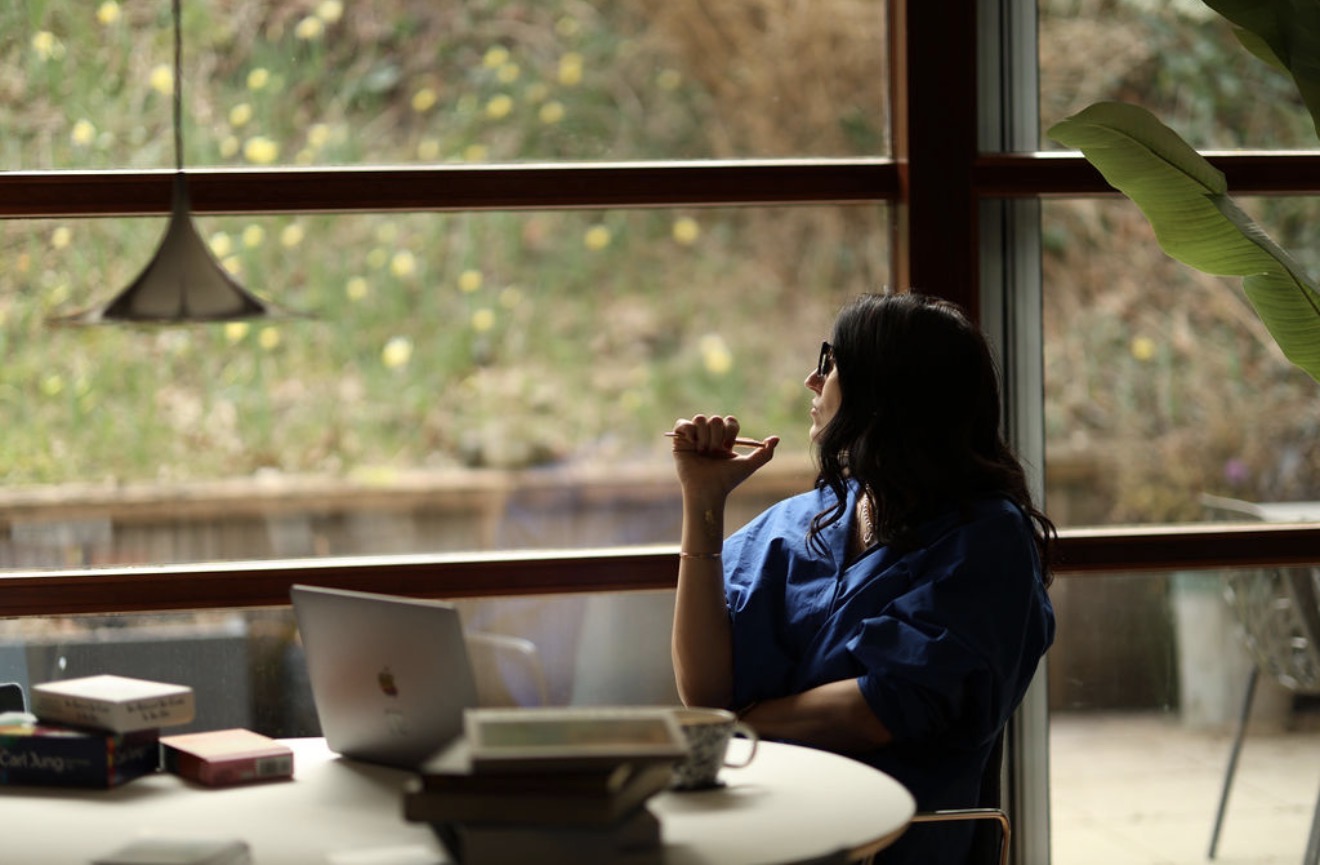
My Story
I wrote this as a personal story about how far we can wander from our calling — and still, eventually, find our way back to it.
My name is Larysa Polishchuk-Rusina. I am a psychologist, artist, and art therapist. Sometimes I feel that my entire life has been a journey through different universes: first imaginary ones, then artistic ones, and now — the inner universes of people.
As a child, I wanted to become an astronaut.

I was endlessly fascinated by space — its vastness, the unknown, the possibility of seeing something I had never seen before. But my mother told me I was too tall to become an astronaut.
So I decided I would become a doctor. My mother is a doctor herself, and this time she tried to talk me out of that too. She told me that medicine was an incredibly demanding profession and an enormous responsibility.
Fine, I thought. Then I will become an artist.
But my mother had an argument for that as well: artists were poor, it was difficult to make a living from art, and I should choose something more serious.
Life has a wonderful sense of humor.
About twenty years later, I became an artist after all. And as I approached forty, I became a psychologist.
And somehow, I think I became an astronaut after all, too.
Only instead of travelling into distant space, I have spent my life exploring other universes — the worlds of images and colour, the human psyche, memory, trauma, love, loss, choice, and recovery.
I was born in Kyiv, Ukraine, in 1985. In 2006, I graduated from the Faculty of Philosophy at Kyiv National University, earning a Master’s degree in Philosophy with a specialization in Aesthetics.
My graduation thesis, Colour in Cinematography, became the foundation for my later experiments with colour and light in photography and video.
From 2004 to 2009, I worked on commercial photography projects, collaborated with Ukrainian and international publications, collectors, and private clients, and participated in contemporary art projects as an art manager. Since 2009, I have pursued my own independent visual research and participated in solo and group exhibitions in Ukraine and internationally.
I worked with Boris Mikhailov and Viktor Marushchenko. In 2012, I was selected to represent Ukraine in London at the Rich Mix Festival. In 2019, I was included among PhotoVogue photographers and participated in The Shadow of Dream by Open Group, presented at the Ukrainian Pavilion during the 58th International Art Exhibition of La Biennale di Venezia.
In 2020, my work was presented on Saatchi Art and in Seoul as part of Kreative Perspectives, a contemporary Korean-Ukrainian photography exhibition at KF Gallery, supported by the Embassy of Ukraine in Korea.
And then came 2022.
Because of the full-scale war, I was forced to leave Ukraine. My life, like the lives of millions of Ukrainians, was divided into a “before” and an “after.”
I found myself in the Netherlands.
And it was here that my story unexpectedly came full circle once again.
Something that had intuitively existed alongside my art for many years — my fascination with people, their inner worlds, trauma, memory, their capacity to live through loss and recreate themselves — eventually led me to psychology on an academic level.
In the Netherlands, I continued my professional path providing psychological support to Ukrainians and earned my second Master’s degree — this time in Psychology.
Today, I practise as a psychologist in the Netherlands, working with people whose lives, too, have at some point been divided into a “before” and an “after.”
And this is where my two professions finally met.
Twenty years of experience in art did not become part of my past when I entered psychology. On the contrary, they became part of the way I see and understand people.
Art taught me to notice what cannot always be expressed in words. To see nuances. To stay with uncertainty. Not to rush into interpretations. To look at the same story from different perspectives.
Psychology, in turn, has changed my art. It has given me a different depth of understanding of what lies behind an image, the body, memory, fear, intimacy, and the human capacity to recover.
And so today, I can no longer say where the artist ends and the psychologist begins.
Perhaps they were never two different people in the first place.
Sometimes the journey back to ourselves takes twenty years. Sometimes forty.
And sometimes we do, after all, become the person we dreamed of being as a child — just not in the way we once imagined.
I never became an astronaut.
But I have spent my entire life travelling through universes.
Once, through art.
Today, through psychology as well.
And for me, the most complex, fragile, and beautiful universe of all will always be the human being.